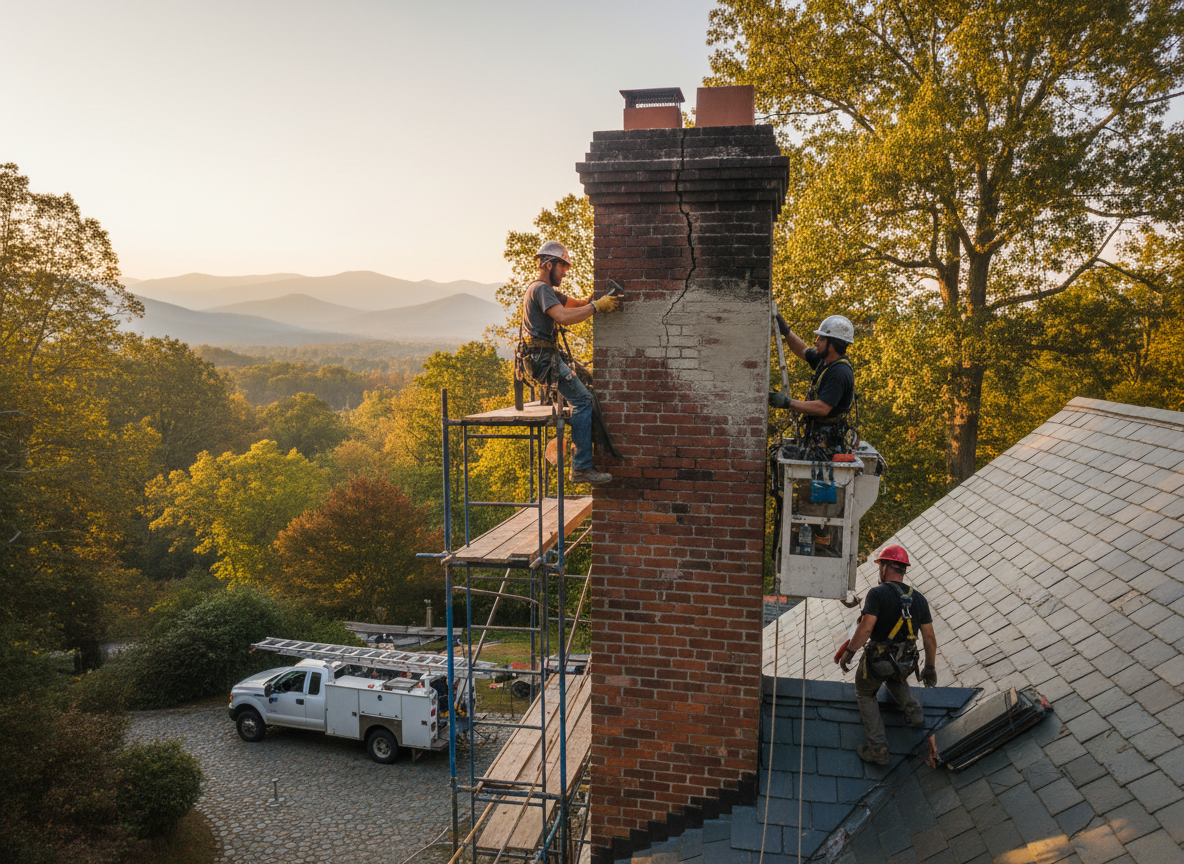
Asheville's older brick homes in neighborhoods like Montford and Grove Park often date to the early 1900s, with chimneys built from local clay brick and lime mortar that weathers poorly under repeated freeze-thaw cycles. Heavy mountain rains and high winds funneling through valleys accelerate water intrusion into flue liners and crown joints. Emergency calls frequently involve dislodged caps after storms or creosote buildup igniting during sudden cold snaps, requiring immediate temporary sealing to prevent interior smoke or fire spread before full restoration.
Terrain around Asheville adds access challenges on steep lots common in the River Arts District and Biltmore Village area, where scaffolding must be anchored on slopes rather than flat ground. Mortar failure here often hides behind ivy or siding, and technicians must check for hidden flue separation that allows carbon monoxide migration into living spaces. Local code in Buncombe County requires permits for liner replacements exceeding certain heights, so emergency crews carry temporary stainless steel inserts rated for high-wind exposure until permanent work clears inspection.
Homeowners in the Asheville area frequently overlook how pine needle debris from surrounding forests combines with rain to form dense blockages that force smoke back into rooms during power outages. Emergency repair prioritizes clearing the obstruction, then addressing any resulting crown cracks with refractory cement matched to the original brick color to maintain historic district appearance. These jobs demand rapid assessment of draft issues caused by the region's variable barometric pressure before winter sets in.
Technician insight
In Asheville, the thing that catches most people out with emergency chimney repair is how the steep terrain around neighborhoods like Montford funnels wind that pries open mortar joints hidden behind years of ivy growth; homeowners assume a blocked flue is the only issue until smoke tests reveal separation that only shows up during a hard rain.
Storm-Damaged Chimney on Hillside Lot
Heavy winds dislodged several bricks and cracked the crown on a 1920s brick chimney in the Montford district. Inspection revealed water had entered the flue liner and begun deteriorating the clay. Crew installed a temporary stainless cap and sealed the crown the same day, then returned to repoint and reline once weather cleared, restoring full draft without interior smoke issues.
How it works
- 1
Initial Call and Triage
Technician gathers details on symptoms like smoke spillage or visible cracks and dispatches the nearest crew from the 4 Herman Avenue Ext base for fastest arrival in Asheville traffic.
- 2
On-Site Safety Inspection
Full flue scan with camera plus exterior check for loose bricks or cap displacement, noting wind exposure on the specific hillside or valley lot.
- 3
Temporary Stabilization
Install weatherproof cover or insert to restore safe draft and prevent further water entry or carbon monoxide risk until permanent materials arrive.
- 4
Permanent Repair Execution
Remove damaged sections, repoint with compatible mortar, replace liner if needed, and restore crown and flashing to match original construction.
- 5
Final Testing and Cleanup
Perform smoke and draft test, remove all debris, and provide written report for Buncombe County records before leaving the property.
Pricing
Upfront quotes given after inspection; final cost depends on access difficulty on steep lots and extent of hidden flue damage common in older Asheville homes.